
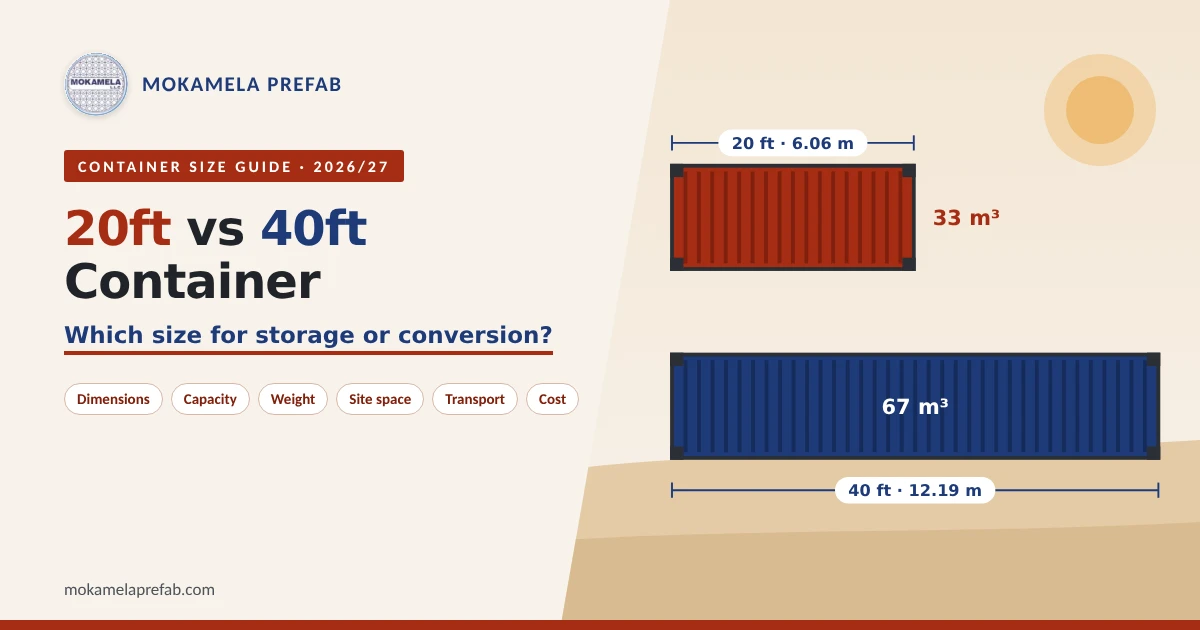
Choosing between a 20ft and a 40ft container looks simple: one is twice as long. In practice, the choice affects your budget, your site layout, how the unit is delivered, and how well it works once it’s in place. This guide compares the 20ft vs 40ft container across every factor that matters, so you can pick the right size for storage or conversion in Saudi Arabia.
Quick Answer: 20ft or 40ft?
- Choose a 20ft container if space on site is tight, you’ll move it often, or you need secure storage for tools and equipment. It’s also easier to deliver and position.
- Choose a 40ft container if you need maximum storage volume, a larger converted office or workshop, or the lowest cost per square meter.
Rule of thumb: one 40ft container gives about double the space of a 20ft, usually for less than double the cost. However, it needs twice the ground length and better site access.
Container Dimensions: 20ft vs 40ft at a Glance
External sizes follow the international standard ISO 668. Internal sizes vary slightly by manufacturer.
| Dimension | 20ft standard | 40ft standard | 40ft high cube |
|---|---|---|---|
| External length | 6.06 m (20 ft) | 12.19 m (40 ft) | 12.19 m (40 ft) |
| External width | 2.44 m (8 ft) | 2.44 m (8 ft) | 2.44 m (8 ft) |
| External height | 2.59 m (8 ft 6 in) | 2.59 m (8 ft 6 in) | 2.90 m (9 ft 6 in) |
| Internal length | ~5.90 m | ~12.03 m | ~12.03 m |
| Internal width | ~2.35 m | ~2.35 m | ~2.35 m |
| Internal height | ~2.39 m | ~2.39 m | ~2.69 m |
| Floor area (internal) | ~13.9 m² | ~28.3 m² | ~28.3 m² |
| Volume | ~33 m³ | ~67 m³ | ~76 m³ |
Internal figures are typical for standard steel containers. Always confirm the exact specification before ordering.
What Is a High Cube Container?
A high cube is about 30 cm taller than a standard container. That extra height makes a real difference for:
- converted offices, where you need space for insulation and a ceiling
- tall racking in storage units
- workshops with overhead equipment
Capacity: How Much Fits Inside?
Both sizes have the same width and height. Therefore, a 40ft simply gives you twice the floor length.
| Load type | 20ft container | 40ft container |
|---|---|---|
| Standard pallets (1.2 × 1.0 m) | about 10 | about 20-21 |
| Floor area for shelving | ~13.9 m² | ~28.3 m² |
| Typical use | Tools, spare parts, small equipment | Bulk materials, large equipment, archives |
Tip: if you’re storing heavy items like steel, cement bags or machinery parts, weight may limit you before space does. In that case, a 20ft container is often the more practical choice.
Weight: Empty and Loaded
| Weight | 20ft standard | 40ft standard |
|---|---|---|
| Empty (tare) weight | about 2,200-2,300 kg | about 3,700-3,800 kg |
| Typical max gross weight | about 30,000 kg | about 30,000 kg |
A 20ft container can carry almost the same maximum weight as a 40ft in a much smaller space. This makes it the better choice for dense, heavy cargo.
Site Space and Access
This is where many buyers get caught out. A container is only useful if you can get it onto your site and place it where you need it.
Space Needed on Site
- Footprint: a 40ft needs about 12.2 m of clear, level ground, while a 20ft needs about 6.1 m.
- Door clearance: allow space in front of the doors to open them fully and load items.
- Crane or truck access: the delivery vehicle needs room to approach and offload.
Access Questions to Check
- Is the gate wide and high enough for a loaded truck?
- Are there overhead cables, trees or structures in the way?
- Can a crane or side-lifter reach the placement spot?
- Is the ground level and firm enough to support the load?
Verdict: on tight urban sites in Riyadh or Jeddah, a 20ft is often the only practical option.
Transport and Delivery in Saudi Arabia
Both sizes are designed for road transport, but they’re handled differently.
| Handling | 20ft | 40ft |
|---|---|---|
| Truck type | Standard flatbed or skeletal trailer | Longer trailer required |
| Offloading | Crane, side-lifter, sometimes large forklift | Crane or side-lifter |
| Fork pockets | Often fitted | Usually not fitted |
| Repositioning on site | Easier | Needs heavier equipment |
Both containers are 2.44 m wide, so they fit within the 2.6 m maximum truck width set by the Roads General Authority. A high cube’s extra height, however, means the trailer and route need checking against the 4.8 m height limit.
Verdict: if the container will move between sites often, a 20ft is cheaper and simpler to relocate.
Cost: Which Gives Better Value?
Container cost depends on:
- new vs used condition
- standard vs high cube
- level of modification (doors, windows, insulation, electrics)
- delivery distance and offloading method
In general:
- Price per container: a 40ft costs more than a 20ft, but usually not double.
- Price per square meter: a 40ft is usually cheaper.
- Delivery: a 40ft can cost more to transport and offload, especially to remote sites.
- Conversion cost: fitting out a 40ft costs more overall, but less per square meter.
Bottom line: if you’ll use all the space, a 40ft is better value. If you’d leave half of it empty, a 20ft saves money.
Best Size for Storage
| Storage need | Best choice | Why |
|---|---|---|
| Tools and small equipment | 20ft | Easy to access, fits small sites |
| Spare parts and consumables | 20ft | Organised shelving, secure |
| Heavy, dense materials | 20ft | Weight limit reached before space |
| Bulk materials and large items | 40ft | More volume per unit |
| Archives and records | 40ft | Long shelving runs |
| Tall items or racking | 40ft high cube | Extra height |
Need much more storage? Once you need several 40ft containers, a steel structure warehouse may be more efficient and easier to manage.
Best Size for Conversion
Containers are popular for conversion into offices, workshops and site facilities. Size makes a big difference to what’s possible.
20ft Conversions
- single site office for 1-2 people
- security or guard room
- small workshop or tool room
- pump, generator or equipment room
40ft Conversions
- multi-room office with 2 rooms or an office + toilet
- larger workshop
- canteen or rest area
- control room with equipment space
Why Width Matters for Conversion
Every container is only about 2.35 m wide inside. Once you add insulation and wall lining for an office, the usable width drops further. This is why containers suit long, narrow layouts best.
Need a wider, more comfortable office? A purpose-built porta cabin is often a better choice. For a full comparison, read our guide on porta cabin vs container. For cabin dimensions, including 3 m wide-body options, see our portable cabin sizes guide.
Heat, Insulation and Saudi Conditions
Steel containers absorb heat quickly in direct sun. Summer temperatures in Saudi Arabia regularly reach the high 40s °C, according to the National Center for Meteorology.
For storage:
- add roof shading or ventilation for heat-sensitive items
- avoid storing chemicals or electronics without temperature control
For conversions:
- full insulation and AC are essential
- a high cube gives room for insulation without losing too much headroom
Coastal sites: in Jeddah, Dammam and Jubail, salt air speeds up rust. Choose good coatings and treat rust spots early.
Safety and Compliance
Converted containers used by people must meet local requirements:
- Fire safety: occupied units must meet Civil Defense requirements
- Electrical and structural work: must follow the Saudi Building Code
- Structural changes: large openings need steel reinforcement to keep the container strong
- Client rules: major clients such as Aramco and NEOM may set their own standards
Decision Guide: 20ft vs 40ft Container
| Question | If yes |
|---|---|
| Is site space limited? | 20ft |
| Will you move it often? | 20ft |
| Are you storing heavy, dense items? | 20ft |
| Do you need maximum volume? | 40ft |
| Do you want the lowest cost per m²? | 40ft |
| Converting to a multi-room office? | 40ft or 40ft high cube |
| Need tall racking or ceiling space? | 40ft high cube |
5 Steps to Choose the Right Size
- List what you’ll store or how you’ll use the space.
- Estimate volume and weight, not just floor area.
- Measure your site and check access routes.
- Decide if it will move during or after the project.
- Compare total cost, including delivery and fit-out, not just the unit price.
Common Mistakes to Avoid
- Buying a 40ft for a site that can’t fit it: check the length and access first.
- Ignoring weight: heavy loads can exceed limits before the container is full.
- Forgetting door clearance: you need space to open the doors and load.
- Converting a standard container to an office without enough headroom: a high cube is often better.
- Leaving containers in direct sun with heat-sensitive contents: add shading or ventilation.
Get the Right Container for Your Project
Mokamela Prefab supplies and converts 20ft and 40ft containers for storage, offices, workshops and site facilities across Saudi Arabia. Tell us what you need and we’ll recommend the right size, modifications and delivery method.
Explore our modified shipping containers, or see our complete guide to prefab & modular construction in Saudi Arabia for other site solutions.
+966 54 540 3028 · sales@mokamela.com · Get a free container quote
Frequently Asked Questions
What are the dimensions of a 20ft container? A standard 20ft container measures about 6.06 m long, 2.44 m wide and 2.59 m high externally. Internally, it’s about 5.90 × 2.35 × 2.39 m.
What are the dimensions of a 40ft container? A standard 40ft container measures about 12.19 m long, 2.44 m wide and 2.59 m high externally. A 40ft high cube is about 2.90 m high.
Is a 40ft container twice the price of a 20ft? Usually not. A 40ft costs more per unit, but less per square meter. Delivery and offloading, however, can cost more.
Which container size is best for a site office? A 20ft suits a single office for 1–2 people. A 40ft, ideally a high cube, suits multi-room offices. For wider, more comfortable offices, consider a porta cabin.
Can a 20ft container hold as much weight as a 40ft? Nearly. Both have a similar maximum gross weight, so a 20ft is often better for heavy, dense cargo.
Leave a Reply