
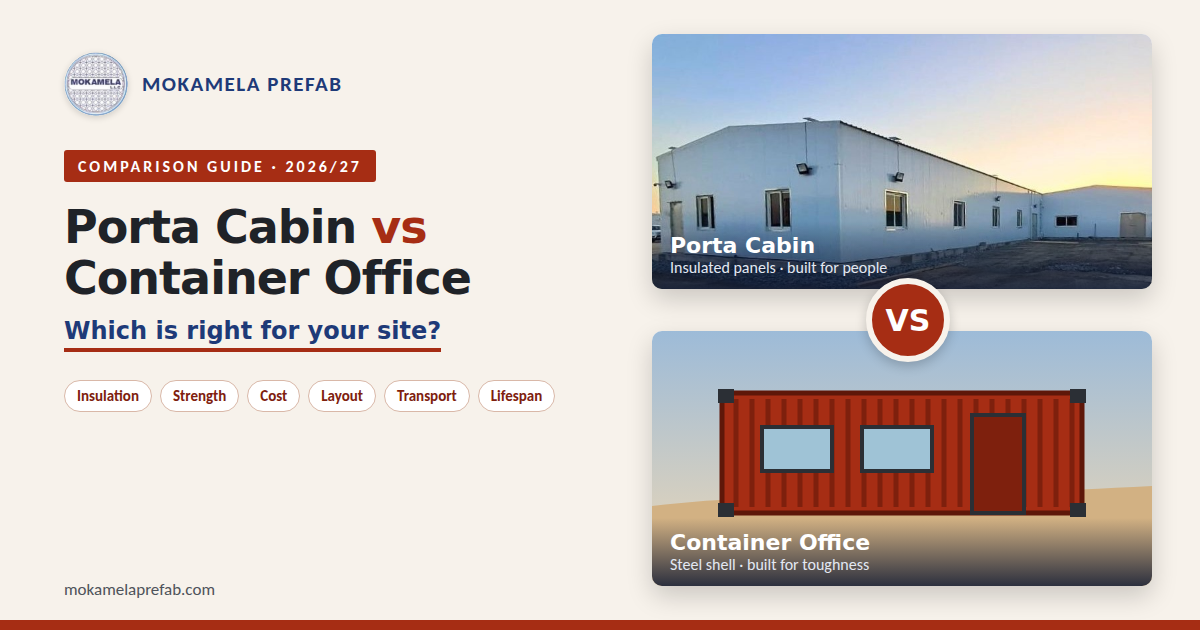
You need a site office, store or welfare unit, and two options keep coming up: a purpose-built porta cabin or a converted shipping container. Both look similar from the outside. However, they’re built differently, perform differently in Saudi heat, and suit different jobs. This guide compares porta cabin vs container side by side, so you can choose with confidence and avoid paying for the wrong unit.
Quick Answer: Porta Cabin vs Container
- Choose a porta cabin for offices, accommodation and any space where people spend long hours. It offers better insulation, more flexible layouts and more size options.
- Choose a container office or unit for storage, workshops and rugged sites where security, strength and frequent relocation matter most.
In short: porta cabins are built for people, while containers are built for toughness.
What Is a Porta Cabin?
A porta cabin is a purpose-built portable building. It’s made from a steel frame with insulated sandwich panels for the walls and roof. Because it’s designed as a building from the start, insulation, windows, doors and services are built in at the factory.
Key traits:
- insulated PU, PIR or rockwool panels
- windows and doors placed almost anywhere
- standard and custom sizes, including 3 m wide-body units
- designed for offices, accommodation, toilets and clinics
Learn more about the main types of portable cabins and their uses.
What Is a Container Office?
A container office, sometimes called a cabin container, is a steel shipping container converted for a new use. Its outer shell is corrugated weathering steel, built to carry cargo across oceans. To make it usable, the converter cuts openings and adds insulation, lining, electrics and AC inside.
Key traits:
- very strong, all-steel structure
- standard 20 ft and 40 ft lengths set by ISO 668
- corner castings for easy lifting and stacking
- excellent security and weather resistance
Porta Cabin vs Container: Side-by-Side Comparison
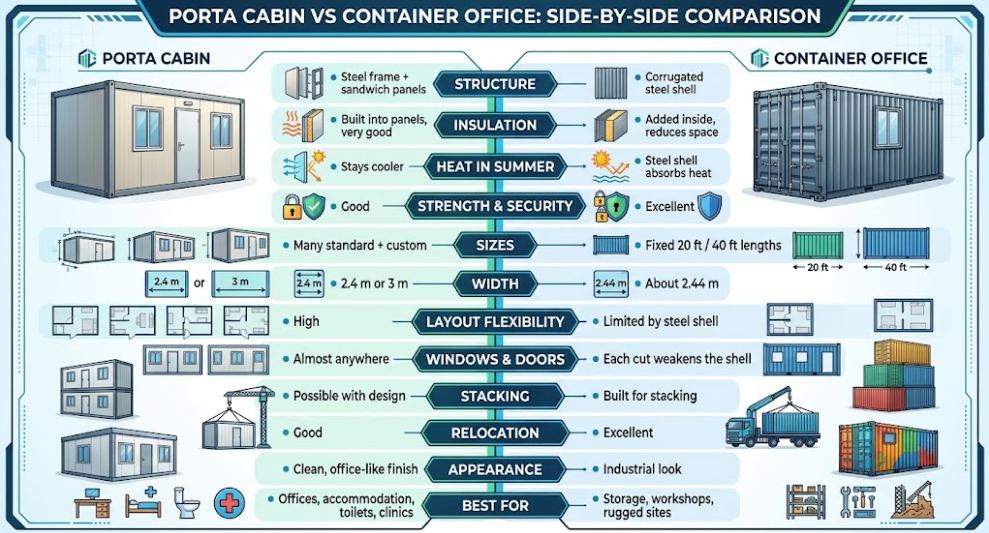
| Factor | Porta cabin | Container office / unit |
|---|---|---|
| Structure | Steel frame + sandwich panels | Corrugated steel shell |
| Insulation | Built into panels, very good | Added inside, reduces space |
| Heat in summer | Stays cooler | Steel shell absorbs heat |
| Strength & security | Good | Excellent |
| Sizes | Many standard + custom | Fixed 20 ft / 40 ft lengths |
| Width | 2.4 m or 3 m | About 2.44 m |
| Layout flexibility | High | Limited by steel shell |
| Windows & doors | Almost anywhere | Each cut weakens the shell |
| Stacking | Possible with design | Built for stacking |
| Relocation | Good | Excellent |
| Appearance | Clean, office-like finish | Industrial look |
| Best for | Offices, accommodation, toilets, clinics | Storage, workshops, rugged sites |
1. Insulation and Comfort in Saudi Heat
This is the biggest difference, and it matters most in the Kingdom. Summer temperatures across Saudi Arabia regularly reach the high 40s °C, according to the National Center for Meteorology.
Porta cabin:
- insulation is part of the wall panel itself
- no large steel surface facing the sun
- AC works efficiently and keeps rooms comfortable
Container office:
- the steel shell heats up quickly in direct sun
- insulation must be added on the inside
- poor conversions can suffer from heat and condensation
Verdict: for spaces where people work or sleep, a porta cabin is usually more comfortable and cheaper to cool.
2. Strength, Security and Durability
Container office:
- thick steel walls resist impact and forced entry
- lockable steel doors
- handles rough handling and harsh sites well
Porta cabin:
- strong enough for normal site use
- less resistant to impact than a steel container
- security can be improved with steel doors and window bars
Verdict: if theft, impact or harsh handling is your main concern, a container wins.
3. Size, Space and Layout
Containers come in fixed lengths. Porta cabins are far more flexible.
| Porta cabin | Container | |
|---|---|---|
| Lengths | 3 m, 6 m, 12 m and custom | 20 ft and 40 ft |
| Widths | 2.4 m or 3 m | About 2.44 m |
| Internal height | About 2.5–2.7 m | Standard or high cube |
| Internal width after insulation | Close to external | Noticeably reduced |
Because containers are insulated on the inside, every layer of insulation and lining reduces your usable width.
For detailed dimensions, see our guide to portable cabin sizes.
4. Customisation and Fit-Out
Porta cabin:
- place windows, doors and partitions where you need them
- easy to add toilets, pantries and multiple rooms
- easy to join several units into a larger building
Container office:
- every opening cut into the steel weakens the structure
- large openings need extra steel reinforcement
- internal layouts are limited by the narrow fixed shell
Verdict: for multi-room offices or accommodation, choose a porta cabin. For a simple open store or workshop, a container works well.
5. Transport and Relocation
Both units travel well, but containers have an edge for frequent moves.
Container advantages:
- corner castings allow quick crane lifting and secure twist-lock fixing
- designed to be stacked and moved repeatedly
Porta cabin considerations:
- has lifting points and travels well on standard trailers
- 3 m wide-body cabins exceed the 2.6 m standard truck width set by the Roads General Authority, so they may need special transport
Verdict: if your unit will move between sites several times, a container is often easier.
6. Cost: Which Is Cheaper?
There’s no single answer. The real cost depends on:
- New vs used: a used container shell can be cheap, but conversion adds significant cost
- Insulation level: properly insulating a container costs more than a factory-insulated cabin panel
- Fit-out: windows, AC, electrics and plumbing cost money in both cases
- Size: a custom-size porta cabin can avoid paying for space you don’t need
As a general guide:
- For basic storage, a container is often the most economical choice.
- For a comfortable office or accommodation, a porta cabin is usually better value once you include insulation and fit-out.
For a full breakdown of cabin costs, read our porta cabin price guide.
7. Lifespan and Maintenance
Both units last many years with proper care. However, they need different maintenance.
Porta cabin:
- check panel joints and seals regularly
- maintain the roof to prevent leaks
- service AC units before summer
Container:
- treat rust spots before they spread, especially in coastal areas
- check that cut openings and welds stay sealed
- inspect the floor for wear in heavy-use stores
Coastal sites: in Jeddah, Dammam and Jubail, salt air speeds up corrosion. Choose galvanised frames and quality coatings, whichever unit you pick.
8. Safety and Compliance
Whichever you choose, the unit must meet local requirements:
- Fire safety: occupied units, especially accommodation, must meet Civil Defense requirements
- Electrical and structural work: must follow the Saudi Building Code
- Materials: panels, fittings and electrical parts should meet relevant SASO standards
- Client rules: major clients such as Aramco and NEOM may specify fire-rated panels or approved suppliers
Tip: fire-rated rockwool porta cabins are often easier to approve for accommodation than converted containers.
Which Should You Choose? A Simple Decision Guide
| Your main need | Best choice |
|---|---|
| Site office for long working hours | Porta cabin |
| Worker or staff accommodation | Porta cabin |
| Toilet, shower or clinic | Porta cabin |
| Multi-room office with meeting room | Porta cabin |
| Tool or material store | Container |
| Workshop or equipment room | Container |
| High theft risk | Container |
| Frequent relocation between sites | Container |
| Short-term need (a few months) | Rent either |
5 Questions to Ask Before You Decide
- Will people spend long hours inside? If yes, choose a porta cabin.
- Is security the top priority? If yes, choose a container.
- Do you need several rooms or a toilet? If yes, choose a porta cabin.
- Will the unit move often? If yes, a container is easier.
- How long do you need it? For a few months, consider porta cabin rental instead of buying.
Can You Use Both?
Yes, and many sites do. A common setup is:
- porta cabins for offices, accommodation and welfare
- containers for tool stores, spare parts and workshops
This combination gives your team comfortable working space while keeping valuable equipment secure.
Common Mistakes to Avoid
- Using an uninsulated container as an office: it can become dangerously hot in summer.
- Cutting too many openings in a container: this weakens the structure without proper reinforcement.
- Choosing on price alone: a cheap unit that’s too hot to use costs more in lost productivity.
- Ignoring fire rules for accommodation: this can delay approvals and handover.
- Forgetting transport limits: wide units can add delivery cost.
Get Expert Advice for Your Site
Not sure which suits your project? Mokamela Prefab supplies both purpose-built porta cabins and modified containers, so we’ll recommend what fits your use, site and budget, not what’s easiest to sell.
For office layouts specifically, explore our porta cabin offices.
📞 +966 54 540 3028 · 📩 sales@mokamela.com · Get free advice and a quote
Frequently Asked Questions
What is the difference between a porta cabin and a container?
A porta cabin is purpose-built with insulated panels on a steel frame. A container office is a converted steel shipping container. Cabins are more comfortable and flexible, while containers are stronger and more secure.
Is a container office hotter than a porta cabin?
Usually, yes. The steel shell absorbs heat, and insulation must be added inside. A well-insulated porta cabin generally stays cooler with less AC.
Which is cheaper, a porta cabin or a container?
For basic storage, a container is often cheaper. For a comfortable office or accommodation, a porta cabin is usually better value once insulation and fit-out are included.
Can a container be used for accommodation?
It can, but it needs proper insulation, ventilation and fire safety measures. For most accommodation, fire-rated porta cabins are easier to approve and more comfortable.
Which lasts longer, a porta cabin or a container?
Both last many years with good maintenance. Containers resist impact better, while porta cabins need care at panel joints and roofs. Coastal sites need extra corrosion protection for both.
Leave a Reply